Anchored on Meta’s HSTU paper (“Actions Speak Louder than Words: Trillion-Parameter Sequential Transducers for Generative Recommendations”, ICML 2024), this survey traces how recommendation systems are migrating from feature-engineered DLRMs to end-to-end generative transducers — and why this shift unlocks the same power-law scaling that LLMs enjoy.
1. Why Scaling Laws Matter for RecSys — and Why DLRMs Hit a Wall
1.1 The LLM playbook does not transfer for free
In NLP and vision, the recipe is well understood: bigger model + more data + more compute → predictably better loss, governed by Hoffmann/Kaplan power-laws. In ranking and retrieval, this recipe historically failed:
- The classical DLRM stack (Naumov et al., 2019) is dominated by sparse embedding tables (often >99% of params), with a thin MLP on top of dense and crossed features.
- Ardalani et al. (Understanding Scaling Laws for Recommendation Models, 2022) characterize scaling along three axes — data, parameters, compute — and report that parameter scaling has saturated for traditional CTR DLRMs. Adding more embeddings or wider MLPs gives sub-linear, often flat, returns. Data scaling is the only remaining lever.
- Embedding tables grow to terabytes, but compute (FLOPs/example) is small and largely sequential — so accelerator utilization is poor.
1.2 The four “no-free-lunch” obstacles
Anyone who has tried to scale a production ranker has seen these:
- Cardinality and non-stationarity. Item catalogs are O(10⁹), churn daily; user vocabularies are O(10⁹) too. A static tokenizer and frozen-vocab transformer don’t fit.
- Heterogeneous features. Categorical IDs, numerics, cross features, multi-modal content, contexts (time/geo/device). Plugging them all into one sequence is non-trivial.
- Latency budget. Ranking serves at p99 < 100 ms over thousands of candidates per request. A vanilla transformer over an 8K user history × 1K candidates is infeasible.
- Streaming, online learning. Users churn, items launch, signals decay. Models must update continuously, which conflicts with epoch-based pretraining recipes.
1.3 What “generative” actually buys you
Re-framing recommendation as next-token / next-action prediction over a unified user-action sequence converts the bottleneck from embedding-table size to compute on the sequence model. That puts RecSys back on the same accelerator-friendly curve as LLMs: more FLOPs, more parameters in the dense backbone, more data → better quality, predictably. HSTU’s headline result is exactly this — a power-law over 3 orders of magnitude of training compute, up to GPT-3 / LLaMA-2 scale.
Figure 1 — The paradigm shift. DLRMs spend their parameter budget on huge sparse embedding tables and a thin MLP; generative recommenders move the budget into a dense sequence backbone whose FLOPs are predictable, accelerator-friendly, and scale with depth.
flowchart LR
    subgraph DLRM["Classical DLRM (~2019-2022)"]
        direction TB
        A1[User & Item IDs
+ dense + cross feats] --> A2["Sparse Embedding Tables
(TB-scale, >99% of params)"]
        A2 --> A3[Feature Interaction
Cross-Net / DCN / DeepFM]
        A3 --> A4[Thin MLP Head]
        A4 --> A5[CTR / CVR Logit]
    end
    subgraph GR["Generative Recommender (2024+)"]
        direction TB
        B1["User Action Stream
(item, action, time, ctx)..."] --> B2[Token & Position
+ Action Embeddings]
        B2 --> B3["Deep Sequence Backbone
(HSTU / MoE Transformer)
Most params here, FLOPs scale"]
        B3 --> B4[Generative Head:
next-action / next-item /
Semantic-ID codewords]
        B4 --> B5[Retrieval AND Ranking]
    end
    DLRM -.->|"parameters saturate
(Ardalani 2022)"| GR
    style A2 fill:#fde,stroke:#a44
    style B3 fill:#def,stroke:#48a
2. The Anchor Paper: HSTU (Meta, ICML 2024)
Zhai et al., Actions Speak Louder than Words, arXiv:2402.17152
2.1 Reformulation: ranking and retrieval as one sequence
HSTU unifies retrieval and ranking into a sequential transduction task on a single chronological stream of (user, item, action) tokens. “Actions” — clicks, watches, purchases, dwell, like — are first-class tokens, not auxiliary labels. Hence the title: actions (behavior) carry more signal than words (textual descriptions) for recommendation.
2.2 The HSTU block
A dense transformer-style block but explicitly co-designed for high-cardinality streaming data:
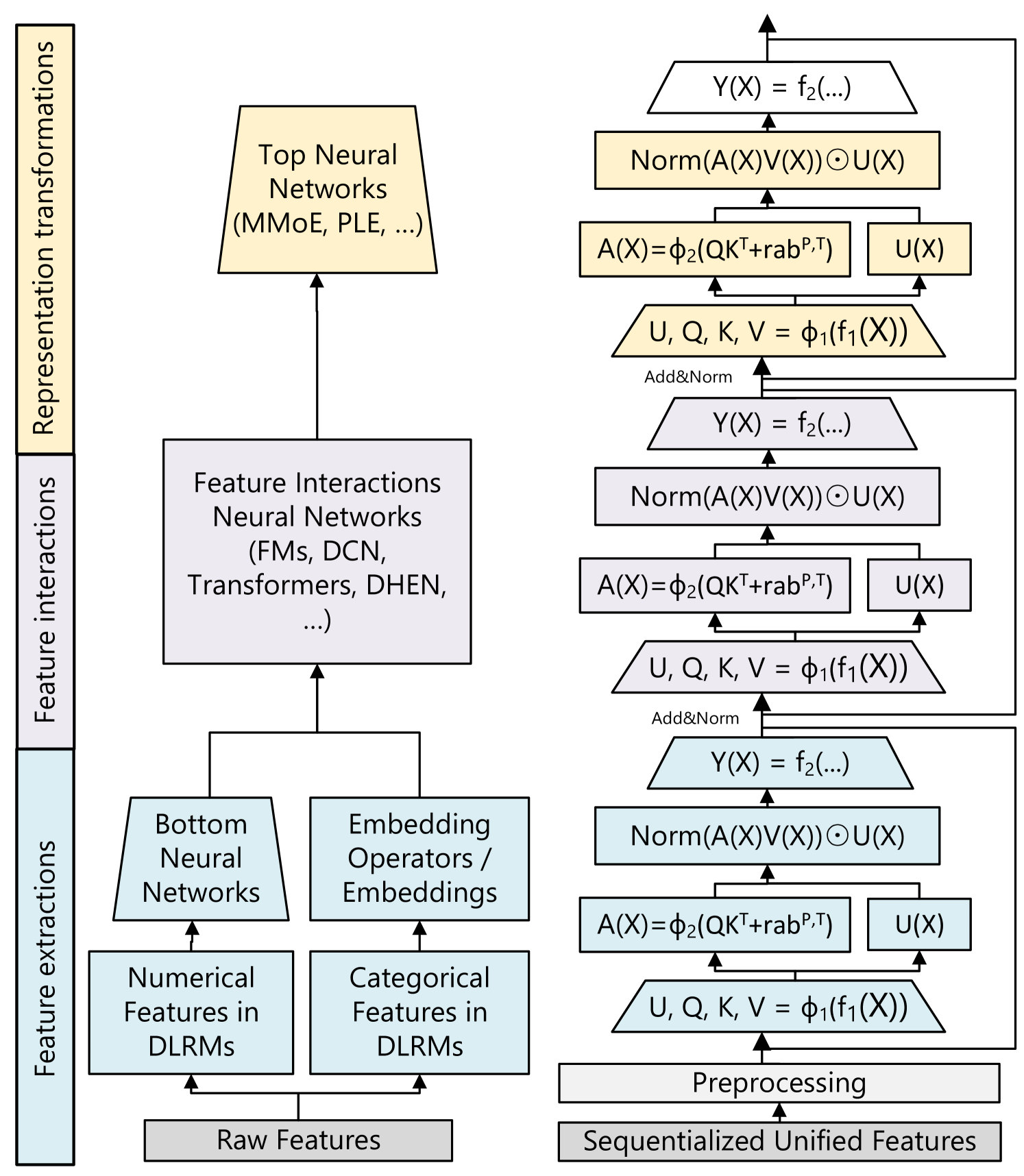
U, V, Q, K = Split(φ₁(f₁(X)))                   # pointwise SiLU projections
A(X)V(X) = φ₂(Q Kᵀ + rab^{p,t}) V               # pointwise (no softmax) attention + relative bias
Y(X)    = f₂( Norm(A V) ⊙ U(X) )                # element-wise gating instead of FFN
Figure 2 — Inside one HSTU block. Compared to a vanilla transformer, the block has four projections (U, V, Q, K) instead of three; the attention is normalized pointwise (SiLU) rather than over the row (softmax); and the FFN is replaced by an element-wise gate Norm(A·V) ⊙ U that performs multiplicative feature interaction.
flowchart TD
    X["Input X
(action-token sequence)"] --> F1["f₁ (linear) + φ₁ (SiLU)"]
    F1 --> SPL[Split into 4 streams]
    SPL --> U["U(X)
gate stream"]
    SPL --> V["V(X)"]
    SPL --> Q["Q(X)"]
    SPL --> K["K(X)"]
    Q --> QKT["QKᵀ + rab^{p,t}
(relative pos + time bias)"]
    K --> QKT
    QKT --> PHI2["φ₂ (SiLU, NO softmax)"]
    PHI2 --> AV["A(X) · V(X)"]
    V --> AV
    AV --> NORM[LayerNorm]
    NORM --> GATE["⊙ U(X)
(element-wise gate)"]
    U --> GATE
    GATE --> F2["f₂ (linear)"]
    F2 --> Y["Y (output)"]
    style PHI2 fill:#def,stroke:#48a
    style GATE fill:#fed,stroke:#a84
    style QKT fill:#efe,stroke:#4a4
Figure 3 — Side-by-side: Transformer block vs HSTU block. The two changes that matter most for ranking quality at scale are (1) pointwise attention normalization and (2) element-wise multiplicative gating in place of an FFN.
flowchart LR

    subgraph T["Vanilla Transformer Block"]
        direction TB
        T1[Input] --> T2[QKV projection]
        T2 --> T3["Softmax(QKᵀ/√d)"]
        T3 --> T4["·V"]
        T4 --> T5[Add & Norm]
        T5 --> T6[FFN: 2-layer MLP]
        T6 --> T7[Add & Norm]
    end

    subgraph H["HSTU Block"]
        direction TB
        H1[Input] --> H2["UVQK projection
(4 streams, SiLU)"]
        H2 --> H3["Pointwise φ₂(QKᵀ + rab)"]
        H3 --> H4["·V → Norm"]
        H4 --> H5["⊙ U (gate)"]
        H5 --> H6[Linear out]
    end

    T <----> H

    style T3 fill:#fcc
    style H3 fill:#cfc
    style T6 fill:#fcc
    style H5 fill:#cfc
Three departures from a vanilla transformer:
| Design | HSTU choice | Why |
|---|---|---|
| Attention normalization | Pointwise (SiLU), no softmax | Softmax is dominated by frequent-item patterns; pointwise preserves intensity signal needed for ranking. |
| Feature interaction | Element-wise gating Norm(AV) ⊙ U | Replaces FFN; gives multiplicative cross-feature interaction that DLRM-style cross modules used to provide. |
| Position info | Relative attention bias rab^{p,t} with both position and time | Recommendation cares about wall-clock time deltas, not just token order. |
Ablation (Table 4 in the paper, 100B examples): swapping pointwise attention back to softmax degrades ranking NE from 0.4937 → 0.5067, and a vanilla transformer is unstable (NaN) at this scale.
2.3 M-FALCON: how ranking 1K candidates over an 8K history becomes feasible
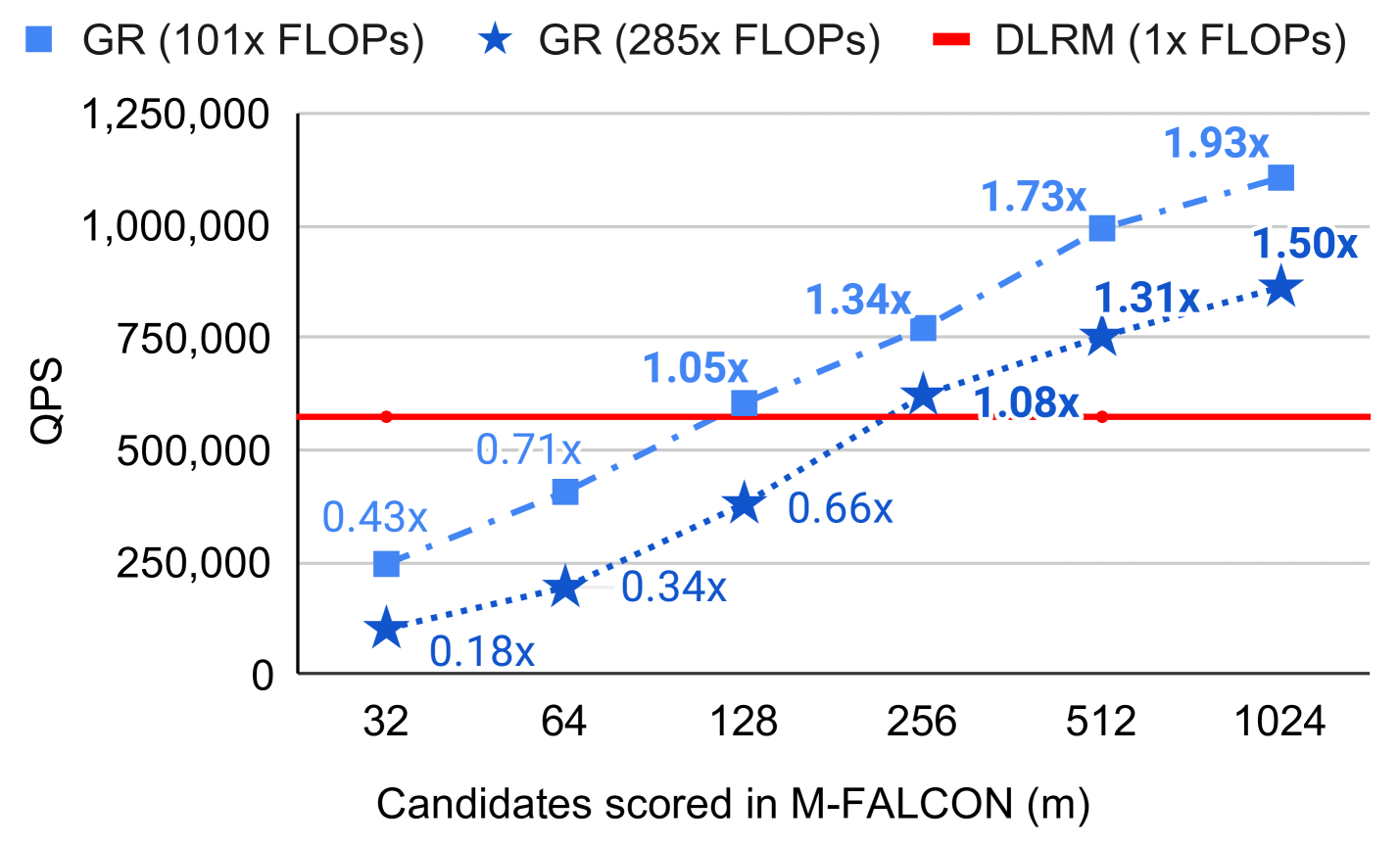
The naive cost of running a transformer over (user_history ∥ candidate) for b_m candidates is O(b_m · n² · d). M-FALCON modifies attention masks/biases so that the encoder pass is shared across candidates — only the candidate-specific tail differs — yielding O((n + b_m)² · d). With encoder-level KV caching, Meta reports a 285× more complex cross-attention model at 1.5× the throughput of the prior production model.
Figure 4 — Naive ranking vs M-FALCON micro-batched ranking. Top: per-candidate forward pass repeats the user-history encode b_m times. Bottom: encode the user history once, cache the KV state, then attend b_m candidate tails against the same cache.
flowchart TB
    subgraph N["Naive cross-attention ranking — O(b_m · n² · d)"]
        direction LR
        H1["User history (n=8K)"] --> E1["Encoder pass #1"] --> C1[Score cand₁]
        H2["User history (n=8K)"] --> E2["Encoder pass #2"] --> C2[Score cand₂]
        H3[...] --> E3[...] --> C3[...]
        H4["User history (n=8K)"] --> E4["Encoder pass b_m"] --> C4["Score cand_{b_m}"]
    end
    subgraph M["M-FALCON — O((n + b_m)² · d)"]
        direction LR
        UH["User history (n=8K)"] --> ENC["Single encoder pass
+ KV cache"]
        ENC --> KV[("Shared KV cache")]
        KV --> S1[Score cand₁]
        KV --> S2[Score cand₂]
        KV --> S3[...]
        KV --> S4["Score cand_{b_m}"]
    end
    N -.->|"share encoder
microbatch tails"| M
    style ENC fill:#def,stroke:#48a
    style KV fill:#efe,stroke:#4a4
2.4 Stochastic Length — sub-quadratic on long histories
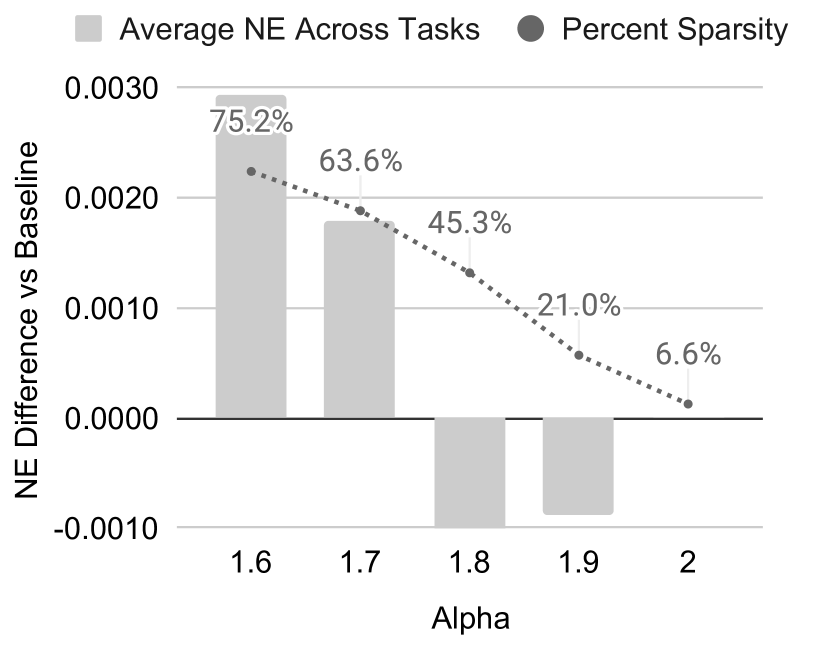
Instead of windowing user history (which destroys long-tail engagement signals), HSTU probabilistically truncates sequences exceeding N^{α/2} with probability 1 − N^α / nᵢ². At α = 1.6 over 4,096-token sequences this gives 80.5% sparsity with only 0.2% NE degradation — and reduces attention to O(N^α · d).
2.5 Headline numbers
Figure 5 — Authoritative figures from the HSTU paper (Zhai et al. 2024). Reproduced via the arXiv HTML build of the paper.
DLRM vs HSTU architecture side-by-side (paper Fig. 3):
Stochastic-length impact on long sequences (paper Fig. 4):
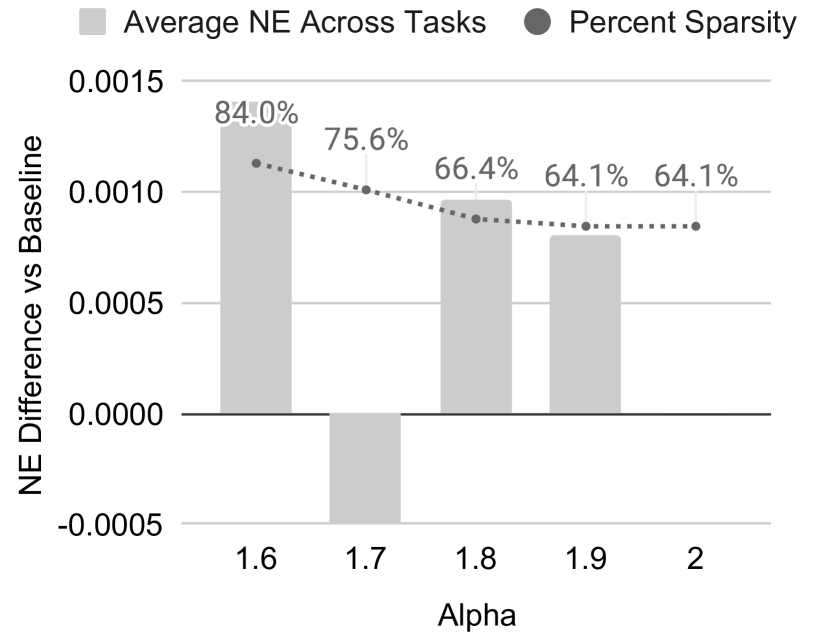
Encoder efficiency — train NE, train speedup, inference speedup (paper Fig. 5):
Scaling-law curves: DLRM vs GR for retrieval and ranking (paper Fig. 7):
Quality: up to +65.8% NDCG over baselines on synthetic / public sets; +12.4% online A/B at deployment.
Speed: 5.3×–15.2× faster than FlashAttention-2 transformers at 8K seq.
Scale: 1.5T parameters, deployed on multiple surfaces serving billions of users.
The headline: model quality scales as a power-law of training compute over 3 orders of magnitude, matching GPT-3 / LLaMA-2 regimes — the first time a recsys has demonstrated this.
This last result is the load-bearing claim of the paper. It promises that the LLM-style “buy more compute, get more quality” investment thesis now applies to recsys.
3. Related Work — Grouped by Generative Strategy
I cluster the (cite > 20) literature into five cohorts, ordered roughly by how much they commit to the generative paradigm.
Figure 6 — Cohort taxonomy. Two orthogonal axes drive the design choice: the item representation (raw ID → text → semantic codeword → action token) and the training objective (discriminative softmax → generative LM → generative transducer at scale).
flowchart TB
    ROOT["Generative Recommendation"]
    ROOT --> A["A. Pre-Generative
(seq transformers)"]
    ROOT --> B["B. LLM-as-Recommender
(text-first)"]
    ROOT --> C["C. Semantic-ID
Generative Retrieval"]
    ROOT --> D["D. Scaling-First Industrial
Generative Recommenders"]
    ROOT --> E["E. Scaling-Law
Foundations"]

    A --> A1[SASRec — 2018]
    A --> A2[BERT4Rec — 2019]

    B --> B1[P5 — 2022]
    B --> B2[M6-Rec — 2022]
    B --> B3[TALLRec — 2023]
    B --> B4[LLaRA — 2024]

    C --> C1[TIGER — 2023]
    C --> C2[LC-Rec — 2024]
    C --> C3[LEARN — 2025]

    D --> DA["D1. Generative
Transducers"]
    D --> DB["D2. Scaling Feature-
Interaction Backbone"]
    D --> DC["D3. Scaling Long-
Sequence Modeling"]
    D --> DD["D4. Gen. Pretrain →
Discriminative Rank"]

    DA --> D1[HSTU — 2024 / Meta]
    DA --> D3[OneRec — 2025 / Kuaishou]
    DA --> D4[MTGR — 2025 / Meituan]
    DA --> D6[PinRec — 2025 / Pinterest]

    DB --> D2[Wukong — 2024 / Meta]
    DB --> D5[RankMixer — 2025 / ByteDance]
    DB --> D7[TokenMixer-Large — 2026 / ByteDance]
    DB --> D8[HHFT — 2025 / Alibaba]
    DB --> D9[OneTrans — 2025 / ByteDance]
    DB --> D10[HyFormer — 2026 / ByteDance]

    DC --> D11[LONGER — 2025 / ByteDance]
    DC --> D12[GEMs — 2026 / Kuaishou]
    DC --> D13[Make It Long Keep It Fast — 2025 / Douyin]
    DC --> D14[ULTRA-HSTU — 2026 / Meta]

    DD --> D15[GPSD — 2025 / Alibaba]

    E --> E1[Ardalani et al. — 2022]
    E --> E2[Climber — 2025]

    style D fill:#def,stroke:#48a
    style D1 fill:#def
    style C fill:#efe,stroke:#4a4
    style B fill:#fed,stroke:#a84
Figure 7 — Timeline of key papers. The 2022–2024 window contains both the diagnosis (Ardalani’s scaling-law paper) and the cure (HSTU). 2025 is the year industrial replication arrived from every major short-video / e-commerce platform; 2026 is when the focus shifts to bending the curve and to fusing long-sequence + feature-interaction scaling into one backbone.
timeline
    title Generative Recommendation Milestones
    2018 : SASRec (self-attention)
    2019 : BERT4Rec (bidirectional)
    2022 : P5 (text-to-text)
         : M6-Rec
         : Ardalani — DLRM scaling laws
    2023 : TALLRec (LoRA + LLaMA)
         : TIGER (Semantic IDs + RQ-VAE)
         : LC-Rec
    2024 : HSTU (Meta, 1.5T params, power-law)
         : Wukong (FM-blocks scaling)
         : LLaRA (hybrid prompts)
    2025 : OneRec (Kuaishou) / MTGR (Meituan)
         : LONGER (ByteDance) / RankMixer
         : PinRec (Pinterest) / LEARN
         : GPSD (Alibaba KDD'25)
         : Climber
         : OneTrans (ByteDance, Oct)
         : Make It Long Keep It Fast (Douyin, Nov)
         : HHFT (Alibaba/Taobao, Nov)
    2026 : HyFormer (ByteDance, Jan)
         : ULTRA-HSTU / Bending Scaling Law (Meta, Feb)
         : GEMs (Kuaishou, Feb)
         : TokenMixer-Large (ByteDance, Feb, 15B params)
Cohort A: Sequential Transformer Recommenders (Pre-Generative)
These are the architectural ancestors. They treat recommendation as next-item prediction but keep the discriminative softmax-over-catalog head and per-task training.
| Paper | Year / Venue | Key idea |
|---|---|---|
| SASRec — Kang & McAuley | ICDM 2018 | First self-attention over user sequences; left-to-right next-item prediction. The de-facto baseline for almost every paper below. |
| BERT4Rec — Sun et al. | CIKM 2019 | Bidirectional encoder with Cloze (masked-item) training. Beats SASRec by leveraging both-side context. Uses BERT-style pretraining but no semantic tokens. |
Critique. Both architectures are bound by per-item softmax heads with |V| ≈ 10⁸–10⁹. Memory and compute scale with catalog size, not with model depth, so they don’t access the LLM-style scaling regime. They also lack action-type modeling — every item is a token, every click is a label.
Cohort B: LLM-as-Recommender (Text-First Generative)
These cast recommendation as a text sequence task on top of a pretrained LLM. The hope is to inherit world knowledge and cold-start generalization; the price is poor latency and a semantic gap with collaborative signal.
| Paper | Year | Approach |
|---|---|---|
| P5 — Geng et al. | RecSys 2022 | Unifies rating prediction, sequential rec, explanation, review summarization, direct rec into one text-to-text model with personalized prompts. Pioneered the “Pretrain, Prompt, Predict” paradigm for RecSys. |
| M6-Rec — Cui et al. | 2022 | Repurposes M6 (GPT-3-ish industrial LM) as an open-ended recommender; supports retrieval, ranking, zero-shot, conversation. Adds prompt-tuning + late-interaction + early-exit for serving. |
| TALLRec — Bao et al. | RecSys 2023 | LoRA-tunes LLaMA-7B with two stages (Alpaca tuning → rec instruction tuning). Astonishing data efficiency: AUC 67 with only 16 examples on MovieLens. |
| LLaRA — Liao et al. | SIGIR 2024 | Hybrid prompts: combines ID-based embeddings from a SASRec-like model with textual item features. Curriculum: first text-only, then progressively inject behavioral embeddings. |
Critique. The cohort is academically interesting but not the path to scaling-law gains. The LLM backbone is frozen or thinly fine-tuned, so its dense compute is wasted re-deriving what an embedding table already knows. None of these methods are deployed as the primary ranker at billion-user scale. They shine in cold-start, explanation, and conversational rec — niches where natural language is the right medium.
Cohort C: Semantic-ID Generative Retrieval
The pivotal idea: replace the |V|-way softmax with a short sequence of discrete codewords (a “Semantic ID”) that represent each item, then train an encoder-decoder to autoregressively generate the next item’s codeword sequence. This is a clean port of generative retrieval (à la DSI for documents) to RecSys.
| Paper | Year | Approach |
|---|---|---|
| TIGER — Rajput et al. | NeurIPS 2023 | First Semantic-ID generative recommender. Uses a SentenceT5 encoder over item content → RQ-VAE for hierarchical residual quantization → seq2seq transformer that decodes the next item’s codeword tuple. +17% Recall@5, +29% NDCG@5 over SASRec; strong cold-start because codewords share content semantics. |
| LC-Rec — Zheng et al. | ICDE 2024 | Argues TIGER’s IDs encode only content, not collaborative signal. Adds learning-based vector quantization with uniform semantic mapping and alignment-tuning tasks that teach the LLM to bridge collaborative ↔ language semantics. ~25% hit-rate lift over LLM-rec baselines. |
| LEARN — Jia et al. | AAAI 2025 (Kuaishou) | A practical industrial bridge: a frozen LLM acts as a Content-Embedding Generator (CEG) in a twin-tower setup; the LLM-derived vectors are injected as features into the existing ranker. Pragmatic, conservative, deployable. |
Why this cohort matters. Semantic IDs decouple model depth from catalog size. They also give compositional generalization to brand-new items: any item with content embeddings can be tokenized without retraining. Cold-start improvement is the most consistent empirical win across this cohort.
Open issues. Codebook collapse, the “hourglass phenomenon” in residual quantization, and a quality gap vs. ID-based retrieval on warm head items.
Cohort D: Scaling-First Industrial Generative Recommenders
This is where HSTU lives, alongside the wave of 2024–2026 industrial papers that take HSTU’s recipe (action-token sequence, dense backbone, scaling-law training) and adapt it to their own production constraints. The cohort has grown large enough that I split it into four sub-cohorts by where the scaling pressure is applied: the generative head, the feature-interaction backbone, the user-history length, or via generative pretraining.
D1 — Generative Transducers (unified retrieval + ranking)
| Paper | Owner | Year | Distinctive contribution |
|---|---|---|---|
| HSTU — Zhai et al. | Meta | 2024 | The reference architecture. Pointwise gated attention, M-FALCON, stochastic length, demonstrated power-law scaling. |
| OneRec — Deng et al., tech report | Kuaishou | 2025 | End-to-end retrieval+ranking in one encoder-decoder with sparse MoE for capacity, session-wise generation instead of point-wise next-item, and DPO-style preference alignment with a learned reward model. Deployed for 25% of Kuaishou QPS, +1.6% watch-time, +0.54% app-stay-time. |
| MTGR — Han et al. | Meituan | 2025 | Builds on HSTU but retains DLRM cross-features. Adds Group-Layer Normalization (GLN) for heterogeneous semantic spaces and dynamic masking to prevent leakage. 65× more FLOPs/sample than the prior DLRM. |
| PinRec — Pinterest team | 2025 | First public production-grade generative retrieval at Pinterest scale: outcome-conditioned multi-token generation (condition on repin / click / save). +0.55% time spent, +4.01% Homefeed clicks. |
D2 — Scaling the Feature-Interaction Backbone (the “ranker stays cascade, but goes huge”)
These papers accept the retrieval/ranking cascade and instead push the ranking model itself to billions of params with constant latency, by replacing softmax self-attention with mixing/factorization blocks that GPUs love.
| Paper | Owner | Year | Distinctive contribution |
|---|---|---|---|
| Wukong — Zhang et al. | Meta | 2024 | A non-transformer alternative: stacked factorization-machine blocks, any-order interactions through depth + width. Scaling law over 2 OOMs past 100 GFLOP/example. |
| RankMixer — Zhu et al. | ByteDance | 2025 | Hardware-aware redesign: multi-head token-mixing in place of quadratic attention, lifting Model FLOPs Utilization from 4.5% → 45%. Scales ranker by 100× at constant latency. |
| TokenMixer-Large — ByteDance | ByteDance | 2026 | A direct successor to RankMixer that scales to 15B parameters. Adds a mixing-and-reverting operation, inter-layer residuals, an auxiliary loss, and Sparse Per-token MoE (“Sparse Train, Sparse Infer”) for stable depth. +1.66% e-commerce orders, +2.0% ad ADSS, +1.4% live-streaming revenue. |
| HHFT — Alibaba (Taobao) | Alibaba | 2025 | Hierarchical Heterogeneous Feature Transformer. Three ideas: (1) Semantic Feature Partitioning groups features (user profile, item, behavior) into semantically coherent blocks; (2) Heterogeneous Transformer Encoder with block-specific QKV/FFN to avoid mixing semantic spaces; (3) Hiformer Layer for high-order cross-feature interactions. +0.4% AUC, +0.6% GMV on Taobao. |
| OneTrans — ByteDance | ByteDance | 2025 | One Transformer for everything. A unified tokenizer encodes both sequential and non-sequential features into a single token stream; one transformer block performs sequence modeling and feature interaction. Causal attention + cross-request KV caching make it serveable. +1.53% CTR AUC, +5.68% GMV per user. |
| HyFormer — ByteDance (Douyin Search) | ByteDance | 2026 | Argues current designs decouple long-sequence compression (à la LONGER) from token mixing (à la RankMixer). HyFormer fuses them: Query Decoding expands non-sequential features into Global Tokens that decode over layer-wise KVs of the long behavior sequence; Query Boosting adds cross-query / cross-sequence interactions via efficient mixing. Outperforms LONGER + RankMixer at matched FLOPs on a 3B-sample Douyin Search benchmark. |
D3 — Scaling User-History Length (the 1K → 10K behavior context era)
These papers accept that the bottleneck is no longer model size but behavior-sequence length. The recipe is: decouple history encoding from candidate scoring, share the encoded history across candidates, and use sparse / cross-attention so cost stays linear.
| Paper | Owner | Year | Distinctive contribution |
|---|---|---|---|
| LONGER — ByteDance | ByteDance | RecSys 2025 | “Long-sequence Optimized traNsformer for GPU-Efficient Recommenders.” Three pieces: (1) Global tokens to stabilize attention over long contexts; (2) a token-merge module with InnerTransformers + hybrid attention for sub-quadratic cost; (3) heavy systems work — mixed-precision + activation-recomputation training, KV-cache serving, fully synchronous train/serve framework. Deployed at >10 ByteDance scenarios. |
| GEMs — Kuaishou | Kuaishou | 2026 | Splits a user’s lifelong history into three temporal streams: Recent (one-stage real-time), Mid-term (lightweight indexer), Lifecycle (two-stage offline inference). A parameter-free fusion combines them before the generative decoder, sidestepping the recency bias of pure self-attention over very long contexts. +0.17% app-time, +0.35% video watch-time on Kuaishou Lite. |
| Make It Long, Keep It Fast — ByteDance (Douyin) | ByteDance | 2025 | The Douyin recipe for end-to-end 10K-length history at billion scale. Three innovations: (1) Stacked Target-to-History Cross-Attention (STCA) replaces history self-attention with stacked target→history cross-attn, making cost linear in history length; (2) Request-Level Batching (RLB) aggregates multiple targets per user-request to share user-side encoding; (3) Length-Extrapolative Training trains short, infers long. Reports monotonic, predictable gains as history length scales — the LLM-style scaling law, applied to context. |
| Bending the Scaling Law Curve / ULTRA-HSTU — Meta | Meta | 2026 | Argues the cross-attention-only fix used by Douyin-style methods limits representational power. ULTRA-HSTU does end-to-end model + system co-design of the input sequence, sparse-attention, and topology — yielding >5× faster training scaling and >21× faster inference scaling of the HSTU curve. The first paper to explicitly try to bend (steepen) the existing recsys scaling-law curve rather than just sit on it. |
D4 — Generative Pretraining → Discriminative Ranking
A different bet: keep the discriminative ranker (CTR/CVR is what production cares about) but use a generative pretraining objective on the same backbone to escape overfitting.
| Paper | Owner | Year | Distinctive contribution |
|---|---|---|---|
| GPSD — Wang et al. | Alibaba | KDD 2025 | Generative Pretraining for Scalable Discriminative recommendation. A pretrained generative model initializes a discriminative model, plus a sparse parameter-freezing fine-tune. Closes the generalization gap — quality scales as a power-law of dense parameters from 13K → 0.3B, where vanilla discriminative training overfits. Code released. |
Pattern across the four sub-cohorts. Everyone agrees on:
- Move parameters from sparse embedding tables into a dense backbone whose FLOPs grow predictably.
- Replace or augment softmax self-attention with token-mixing / pointwise / cross-attention that GPUs can saturate.
- KV caching is doing very heavy lifting — it’s what makes 10K histories or 1K candidates affordable at production latency.
- Long-history modeling and feature-interaction scaling are converging (HyFormer, OneTrans) into a single unified backbone.
What they disagree on: what to scale first. D1 scales the generative head, D2 the feature-interaction backbone, D3 the user-history length, D4 the pretraining objective. The 2026 papers (TokenMixer-Large, HyFormer, ULTRA-HSTU) suggest the answer is “all four, jointly”.
Cohort E: Scaling-Law Foundations (No Generative Architecture, but the Theory)
Worth reading because they motivate the rest.
| Paper | Contribution |
|---|---|
| Understanding Scaling Laws for Recommendation Models — Ardalani et al., 2022 | First systematic CTR-model scaling-law paper. Establishes that parameter scaling saturates for DLRMs while data scaling persists. Sets up the diagnosis HSTU later cures. |
| Climber (Wei et al., 2025) | Multi-scale extraction + adaptive temperature modulation; +12.19% online metric in deployment. A scaling-law-friendly transformer variant for recsys. |
| Generative Recommendation: A Survey of Models, Systems, and Industrial Advances, 2025 | The community’s first comprehensive synthesis of the cohort above. |
4. Cross-Method Comparison
4.1 By design axis
| Method | Item representation | Backbone | Output head | Retrieval+Rank? | Industrial scale? |
|---|---|---|---|---|---|
| SASRec | ID embedding | Causal transformer | softmax over ` | V | ` |
| BERT4Rec | ID embedding | Bidirectional transformer | masked-token softmax | Retrieval | Academic baseline |
| P5 / M6-Rec | Text token IDs | T5 / GPT-3 | LM head | Both via prompts | Limited |
| TALLRec / LLaRA | Text + (LLaRA: ID embed) | LLaMA + LoRA | LM head | Ranking via Y/N | No |
| TIGER | RQ-VAE Semantic ID | Encoder-decoder transformer | autoregressive over codewords | Retrieval | No (academic) |
| LC-Rec | Learned VQ ID + LLM | LLM | LM head | Retrieval | Limited |
| LEARN | LLM-derived embedding | Frozen LLM as feature | DLRM ranker on top | Ranking | Yes (Kuaishou) |
| HSTU | Action token sequence | Pointwise-gated transformer | pointwise + neg sampling | Both | Yes (Meta, 1.5T) |
| Wukong | Dense + sparse features | Stacked FMBlocks | Task heads | Ranking | Yes (Meta) |
| OneRec | Item codewords | Encoder-decoder + MoE | session-level seq decoding | Both, unified | Yes (Kuaishou) |
| MTGR | HSTU + DLRM cross-feats | HSTU + GLN | Ranking head | Ranking | Yes (Meituan) |
| RankMixer | Dense feature tokens | Token-mixing blocks | Ranking head | Ranking | Yes (ByteDance) |
| PinRec | Multi-token Semantic ID | Encoder-decoder | outcome-conditioned decoding | Retrieval | Yes (Pinterest) |
| TokenMixer-Large | Dense feature tokens | Mix-and-revert + Sparse-MoE | Ranking head | Ranking | Yes (ByteDance, 7-15B) |
| HHFT | Heterogeneous feature blocks | Block-specific QKV + Hiformer | Ranking head | Ranking | Yes (Alibaba/Taobao) |
| OneTrans | Unified seq + non-seq tokens | Single causal Transformer | Ranking head | Ranking | Yes (ByteDance) |
| HyFormer | Long seq + Global Tokens | Query Decoding + Boosting | Ranking head | Ranking | Yes (Douyin Search) |
| LONGER | Long action sequence (≥1K) | Global tokens + token-merge | Ranking head | Ranking | Yes (ByteDance, 10+ surfaces) |
| GEMs | Lifelong action sequence | Multi-stream decoder | Generative head | Both | Yes (Kuaishou Lite) |
| Make It Long, Keep It Fast | 10K-length history | STCA + RLB + length extrap. | Ranking head | Ranking | Yes (Douyin full traffic) |
| ULTRA-HSTU (Bending Curve) | Action token sequence | HSTU + sparse attention co-design | Both | Both | Yes (Meta) |
| GPSD | Discriminative features | Transformer w/ generative pretrain | CTR/CVR head | Ranking | Yes (Alibaba) |
4.2 By scaling behavior
Figure 8 — Conceptual scaling-law comparison. Schematic only — actual slopes differ by paper. The axes are log-log. The DLRM curve flattens (parameter-saturation regime documented by Ardalani et al.); HSTU/Wukong/OneRec keep going as compute grows.
xychart-beta
    title "Quality vs Training Compute (log-log, schematic)"
    x-axis "Training compute (FLOPs, log)" [1, 2, 3, 4, 5, 6]
    y-axis "Model quality (e.g. NDCG, log scale)" 1 --> 10
    line "DLRM (saturates)" [3, 4.5, 5.5, 6.0, 6.1, 6.1]
    line "HSTU / GR (power-law)" [3, 4.6, 5.8, 6.8, 7.7, 8.5]
line "Wukong / RankMixer" [3, 4.4, 5.5, 6.4, 7.2, 7.9]- SASRec / BERT4Rec / P5 / TALLRec / LLaRA: no published scaling law in the recsys regime. Quality plateaus around mid-size.
- TIGER / LC-Rec: improvement with model size up to ~1B; not yet at LLM-scale curves publicly.
- HSTU: power-law over 3 OOMs of compute, validated up to GPT-3 scale. The reference scaling result.
- Wukong: scaling law over 2 OOMs, valid past 100 GFLOP/example. Confirms HSTU’s claim is not architecture-specific.
- OneRec / MTGR / RankMixer / PinRec: each report internal power-law-like curves (often along compute or parameters), with deployed lifts confirming the trend on real metrics.
- TokenMixer-Large: scales the RankMixer curve to 7B → 15B params, validating that token-mixing scales further than originally shown.
- HHFT / OneTrans / HyFormer: each show monotonic AUC gains as parameters grow at matched FLOPs — and HyFormer explicitly outperforms LONGER + RankMixer baselines at the same compute budget.
- LONGER / GEMs / Make It Long, Keep It Fast: report a new scaling axis — history length — with monotonic gains as user-history extends from 1K → 10K. This is the LLM “context-length” scaling law arriving in recsys.
- ULTRA-HSTU: tries to bend the slope of the existing HSTU curve via co-design — claiming 5×–21× compute-efficiency at matched quality, not just sitting on the same line.
- GPSD: shows quality scales as a power-law in dense parameters from 13K → 0.3B when discriminative training is initialized from a generative-pretrained checkpoint, where vanilla discriminative training overfits.
4.3 By engineering pragmatism (what you actually have to build)
- Easiest to ship for most teams: LEARN (LLM as a feature generator) or RankMixer / TokenMixer-Large (drop-in ranker upgrade). No tokenizer change, no retrieval rewrite.
- Highest ceiling, highest cost: HSTU / OneRec / ULTRA-HSTU — requires unified action-token pipelines, retraining the recall stack, M-FALCON-style serving. Pays back at billion-user scale.
- Cleanest research story: TIGER — Semantic IDs are conceptually elegant and let you reason about cold-start formally.
- Best for hybrid stacks (retain DLRM features): MTGR, HHFT, OneTrans.
- Best for “we already have a 1K-history ranker, give me 10K”: LONGER, GEMs, “Make It Long, Keep It Fast” — they decouple history encoding from candidate scoring and lean on KV caching + cross-attention.
- Best for overfitting-bound discriminative ranking: GPSD — initialize the discriminative model from a generative-pretrained checkpoint to recover scaling.
4.4 What HSTU and its successors agree the community got wrong
- Softmax attention is the wrong head for ranking — it normalizes away intensity. Pointwise / gated / token-mixing alternatives win (HSTU, RankMixer, TokenMixer-Large, HyFormer).
- Cross-features were not the problem; ID-table-shaped models were. Move them into the dense backbone via gating or heterogeneous QKV, don’t discard them (MTGR, HHFT, OneTrans).
- Long histories are the asset, not the cost — stochastic length, target-to-history cross-attention, and request-level batching make 8K–10K sequences cheaper than a 256-token transformer per candidate (HSTU, LONGER, “Make It Long, Keep It Fast”, GEMs).
- Retrieval and ranking are the same task at different temperatures — OneRec and HSTU both bet that one model serves both, freeing up the cascade-loss tax.
- Sequence modeling and feature interaction are not separate stacks — the 2025–2026 wave (OneTrans, HyFormer) collapses them into one transformer block, fed by one tokenizer.
- Discriminative overfitting is curable by generative pretraining — GPSD shows that the same backbone scales further when initialized from a generative objective and partially frozen.
5. Open Questions
- Tokenization is unsolved. Semantic-ID schemes (RQ-VAE) suffer codebook collapse and the hourglass effect; HSTU sidesteps this with raw ID + action tokens but pays in vocabulary explosion.
- Multi-modal fusion at scale. PinRec and OneRec are starting to absorb video / image embeddings into the action stream, but the right way to mix dense semantics with sparse IDs at trillion-scale is open.
- Online learning vs. epoch-based pretraining. Streaming updates are still bolted onto a checkpoint cadence; nothing in this cohort matches the ideal of a continuously-distilling foundation model.
- Evaluation. NDCG/HR@K on MovieLens and Amazon Reviews don’t predict A/B outcomes well at billion-user scale. The community needs a public benchmark that captures non-stationarity.
- Reasoning / agentic recs. Conversational and outcome-conditioned recommendation (PinRec) hint at where the boundary between “recommender” and “agent” dissolves.
6. TL;DR
- DLRMs hit a parameter-scaling wall around 2022. Ardalani et al. quantified it; the field needed a new paradigm.
- HSTU is that paradigm. Reformulate recsys as a generative transduction over action tokens, replace softmax with pointwise gating, swap FFNs for element-wise gates, design serving (M-FALCON) and sparsity (stochastic length) into the architecture itself. The reward is the first power-law scaling curve in recommendation.
- The 2025 industrial wave (OneRec, MTGR, RankMixer, PinRec, LONGER, OneTrans, HHFT, GPSD) validates HSTU’s recipe across companies, with each adding their own pragmatism — MoE, retained cross-features, hardware-aware mixing, outcome-conditioned decoding, generative pretraining for discriminative ranking.
- The 2026 wave (TokenMixer-Large, HyFormer, ULTRA-HSTU, GEMs, “Make It Long, Keep It Fast”) moves past “sit on the curve” into three new directions: bend the curve (ULTRA-HSTU’s co-design), unify long-sequence and feature-interaction scaling (HyFormer, OneTrans), and push history length to 10K+ as a brand-new scaling axis (Douyin, Kuaishou).
- LLM-based and Semantic-ID schemes (P5, TALLRec, LLaRA, TIGER, LC-Rec, LEARN) are complementary, not competitive: they win on cold-start, explanation, and bridging into language modalities, but don’t carry the production ranker today.
- The next 12–24 months will be about unifying tokenization (semantic IDs ↔ action tokens), multi-modal fusion at trillion-scale, online-streaming foundation models, and a unified scaling law over four axes simultaneously: parameters, compute, data, and history length.
Sources
- Actions Speak Louder than Words — HSTU paper (Meta, ICML 2024)
- HSTU — full text v1
- HSTU code (meta-recsys/generative-recommenders)
- Understanding Scaling Laws for Recommendation Models (Ardalani et al., 2022)
- SASRec (Kang & McAuley, ICDM 2018)
- BERT4Rec (Sun et al., CIKM 2019)
- P5 (Geng et al., RecSys 2022)
- M6-Rec (Cui et al., 2022)
- TALLRec (Bao et al., RecSys 2023)
- LLaRA (Liao et al., SIGIR 2024)
- TIGER (Rajput et al., NeurIPS 2023)
- LC-Rec (Zheng et al., ICDE 2024)
- LEARN (Jia et al., AAAI 2025)
- Wukong (Zhang et al., 2024)
- OneRec (Deng et al., 2025) and OneRec Tech Report
- MTGR (Han et al., 2025, Meituan)
- RankMixer (Zhu et al., 2025, ByteDance)
- PinRec (Pinterest, 2025)
- Climber (2025)
- Generative Recommendation: A Survey of Models, Systems, and Industrial Advances (2025)
- Generative Recommendation with Semantic IDs: A Practitioner’s Handbook (2025)
- LONGER: Scaling Up Long Sequence Modeling in Industrial Recommenders (Chai et al., RecSys 2025, ByteDance)
- Scaling Transformers for Discriminative Recommendation via Generative Pretraining — GPSD (Wang et al., KDD 2025, Alibaba)
- OneTrans: Unified Feature Interaction and Sequence Modeling with One Transformer in Industrial Recommender (Oct 2025, ByteDance)
- Make It Long, Keep It Fast: End-to-End 10k-Sequence Modeling at Billion Scale on Douyin (Nov 2025, ByteDance)
- HHFT: Hierarchical Heterogeneous Feature Transformer for Recommendation Systems (Nov 2025, Alibaba/Taobao)
- HyFormer: Revisiting the Roles of Sequence Modeling and Feature Interaction in CTR Prediction (Jan 2026, ByteDance)
- Bending the Scaling Law Curve in Large-Scale Recommendation Systems — ULTRA-HSTU (Feb 2026, Meta)
- GEMs: Breaking the Long-Sequence Barrier in Generative Recommendation with a Multi-Stream Decoder (Feb 2026, Kuaishou)
- TokenMixer-Large: Scaling Up Large Ranking Models in Industrial Recommenders (Feb 2026, ByteDance)
This post is generated by Claude Code.